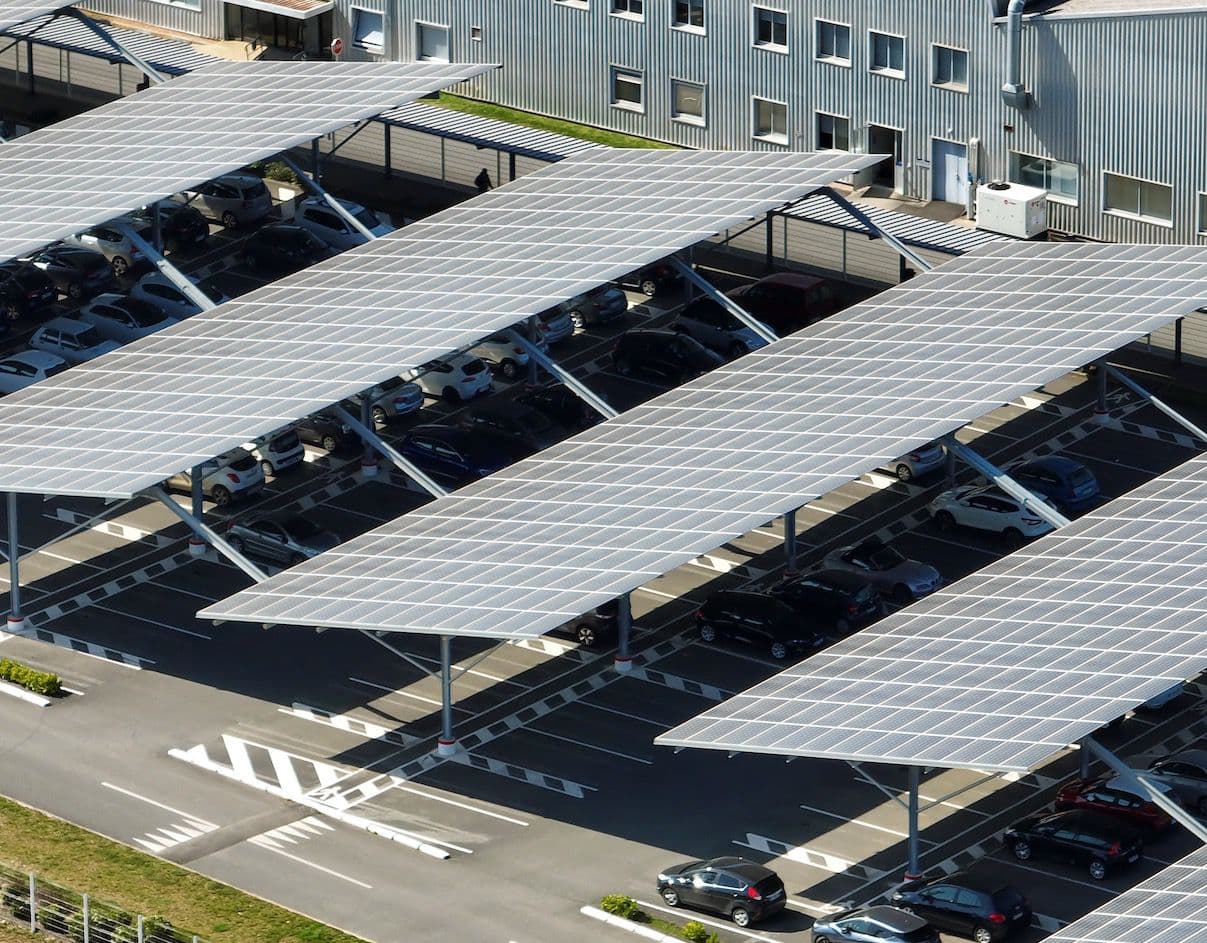
Why the parking lot is the best roof you own
Many commercial properties have more parking than roof, and the parking lot earns nothing. A solar carport changes that: the same paved area keeps its stalls, gains shade and weather cover, and produces electricity a few hundred feet from where it is used.
- No new land, no roof risk. The array sits over existing stalls. There are no roof penetrations, no roof-age questions and no re-roofing to work around.
- Generation on a large scale. A double-row carport typically carries about 2 kW of panels per parking space, so 100 spaces hold roughly 200 kW – often more than the building roof can take.
- Power when it is worth the most. Output is highest in the daytime, when many commercial tariffs charge the most.
- A visible amenity. Shaded, covered parking is something tenants, employees and customers notice every day.
- Ready for EV charging. Charger circuits are cheapest when they are designed into the structure from the start.
- Flexible ownership. Buy it and take the tax benefits, or host a third-party system under a power purchase agreement (PPA) with no upfront capital.
What it saves: worked examples
The table below estimates the first-year value of the electricity from a 100-space carport (about 200 kW) at average commercial prices in four markets. Prices are recent U.S. Energy Information Administration commercial-sector averages, which already blend in fixed and demand charges.
| Market | Commercial price (EIA) | Annual output (est.) | Value of power, year one |
|---|---|---|---|
| U.S. average | 13.5¢/kWh | 280,000 kWh | ~$38,000 |
| Arizona | 12.5¢/kWh | 350,000 kWh | ~$44,000 |
| California | 27.3¢/kWh | 320,000 kWh | ~$87,000 |
| Hawaii | 38.8¢/kWh | 290,000 kWh | ~$112,000 |
Output assumes 1,400–1,750 kWh per kW of panels per year depending on sunshine. These are illustrations, not quotes: actual savings depend on the site's tariff, how much power is used on site rather than exported, and shading.
A real project. At Coyote Valley Casino & Hotel in Mendocino County, California, a 2.23 MW solar carport is expected to produce about 3,472 MWh a year – roughly 45% of the site's use – and more than $450,000 in first-year savings. It was built under a PPA, with no upfront cost and no maintenance responsibility for the owner.
Two things that move the numbers.
- Use the power on site. Many utilities credit exported power at well below the retail price. A canopy sized to the property's daytime load captures the full retail value of every kilowatt-hour.
- Watch the incentive deadline. The federal clean-electricity credit and bonus depreciation can cover a large share of the cost, but projects that start construction after July 4, 2026 must be in service by December 31, 2027. Confirm eligibility with a tax advisor.
Selling the power to your tenants
Multi-tenant properties raise an obvious question: if the owner builds the carport, can the tenants buy the power for less than they pay the utility? In most states, a business that sells electricity to others is regulated as a utility, so the answer depends on the state. Here is what the law says in the markets we serve.
Hawaii – yes, with conditions in the lease
Since 2013, Hawaii law (Act 261, now part of HRS § 269-1) has excluded from the definition of a public utility a property owner who sells power from a renewable system on its own property to its lessees or tenants. The conditions:
- At lease signing, the rate charged to the tenant must be no higher than the utility's effective rate per kWh on its filed schedule.
- The rate schedule or formula is fixed for the term of the lease and written into the lease, with set disclosures.
- The property keeps its utility connection, so tenants can still be served by the utility.
- The owner may not use the utility's lines to deliver the power (no wheeling).
With commercial power averaging close to 39¢/kWh, the margin is real. Selling the 290,000 kWh from the 100-space example at 10% below the utility rate would bring the owner about $101,000 a year and save tenants about $11,000 a year.
California – limited exemption; get legal advice first
California's Public Utilities Code (§§ 218 and 2868) does not treat a solar producer as an electrical corporation when the power is for its own use or the use of its tenants, or is sold to no more than two other parties per system for use on the same or an adjacent parcel. How far a per-kWh charge to many tenants fits within this exemption is not settled, and real-estate counsel have flagged the risk. Owners should take legal advice before billing tenants for solar power.
Other states
Rules vary widely, and many states have no clear exemption. Before promising tenants a power price, check the state utility code and the utility's tariff.
Where direct sales are not allowed
Tenants can still share in the savings:
- Third-party PPA with the tenant. Where the state allows PPAs, a solar provider sells directly to a tenant under its own contract.
- Green-lease cost sharing. The owner uses the power for common areas and recovers part of the cost through operating expenses, as the lease allows.
- Power included in rent. Where permitted, an all-in rent that includes electricity.
- EV charging. Charging sessions sold under the property's own name, where state rules allow.
The bottom line
A solar carport turns the least productive part of a commercial property into an energy asset with a 25-plus-year life. In high-price markets, a 100-space lot can be worth close to six figures a year in avoided power costs, and in Hawaii the law expressly lets an owner sell that power to tenants at or below the utility rate. Elsewhere, the right structure depends on the state – which is why the design, the business model and the contracts should be settled together.
This article is general information, not legal or tax advice.