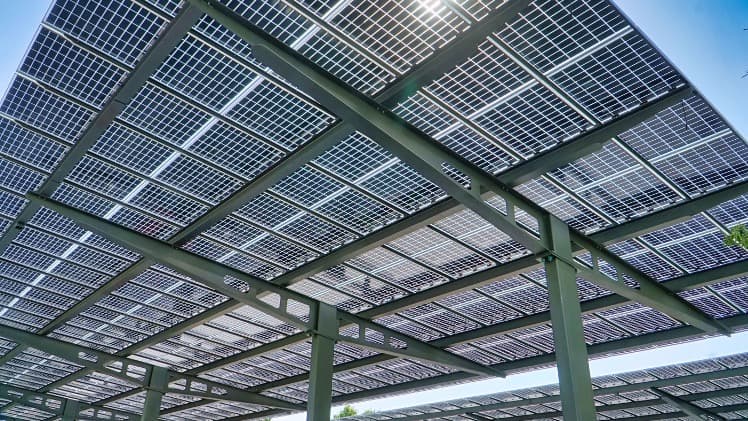
Why the framing material matters
The frame is the part of a solar carport that has to last longest: it carries the panels, the snow and the wind for 25 years or more, and it sets how many columns stand in the parking lot. Most commercial canopies in the United States are framed in hot-dip galvanized structural steel. Extruded aluminum is the main alternative, usually offered as a lighter, bolt-together system.
Both can be engineered to the same building code and the same site loads. What differs is how much material it takes to get there, what it costs, and how each metal behaves over decades outdoors.
At a glance: steel vs. aluminum
| Attribute | Structural steel | Extruded aluminum (6061-T6) |
|---|---|---|
| Minimum yield strength | 50 ksi (A992 beams; A500 Grade C rectangular tubes) | 35 ksi |
| Strength near a weld | No significant loss | About 15 ksi – less than half – within about 1 in of a weld |
| Stiffness (elastic modulus) | 29,000 ksi | 10,100 ksi (about one-third of steel) |
| Weight | 490 lb/ft³ | 169 lb/ft³ (about one-third of steel) |
| Thermal movement, 27-ft span, 100 °F swing | 0.21 in | 0.42 in (twice steel) |
| Corrosion protection | Hot-dip galvanizing to ASTM A123 | Natural oxide film; anodizing or paint optional |
| Design standard | AISC 360 | Aluminum Design Manual (Aluminum Association) |
| Typical connections | Welded or bolted | Mostly bolted, to keep welds out of high-stress zones |
A worked example: one 27-ft beam
To compare like with like, we sized one canopy beam in each metal for the same job: a 27-ft span between columns, panels and framing at 6 psf, and 30 psf of snow, with sag limited to 1/240 of the span (1.35 in). Real projects use their own site loads, including wind uplift.
| Beam | Weight | Strength used | Sag under snow | Result |
|---|---|---|---|---|
| Steel tube 10 × 6 × ¼ in | 24.6 lb/ft | 50% | 1.11 in | Passes |
| Aluminum tube 12 × 4 × ¼ in | 9.1 lb/ft | 61% | 2.41 in | Fails – sags nearly twice the limit |
| Aluminum tube 14 × 6 × 5/16 in | 14.2 lb/ft | 32% | 1.07 in | Passes |
The 12 × 4 aluminum tube is just as strong as a comparable steel tube at less than half the weight – but it sags far too much. Because aluminum is only a third as stiff, the beam has to be made deeper until it stops bending, not until it is strong enough. Sized that way, the passing aluminum beam is 4 in deeper than the steel one, weighs about 58% as much, and uses only a third of its strength.
What that does to cost
At 2026 planning prices – roughly $0.85–$1.25 per lb for galvanized steel and $2.20–$3.20 per lb for aluminum extrusion – the aluminum beam's material costs about 1.5 times the steel beam's: about $845–$1,230 against $565–$830 for each 27-ft beam. Lower freight and lighter lifts recover part of that; labor, foundations and engineering change little between the two.
What about longer spans?
Aluminum can span the same distance as steel – the example above does exactly that – but the gap in depth and cost widens as spans grow, which is why long cantilevers over drive aisles are almost always steel.
Corrosion, heat and fire
- Galvanized steel lasts for decades without maintenance. Hot-dip galvanizing bonds a zinc coating to the steel that protects it twice over: as a barrier, and by corroding first wherever the coating is scratched. In the dry desert air of Nevada and Arizona, a galvanized frame can go more than 100 years before it needs touching up.
- Aluminum shines on the coast. Its natural oxide film needs no coating in most climates, and it is the stronger choice right on the seafront. Galvanized steel can match it there with a duplex system – galvanizing plus paint or powder coat – which lasts 1.5 to 2.3 times the combined life of the two coatings.
- Mixed metals need care. Aluminum and galvanized steel bolts sit close together galvanically and work well together. Aluminum touching bare carbon steel or copper – a grounding conductor, for example – needs isolation, especially in salty air.
- Thermal movement. Aluminum grows and shrinks twice as much as steel with temperature. Long aluminum canopies need slotted connections or expansion joints, and that movement also works on the panel clamps.
- Fatigue. Aluminum has no fatigue limit, so a canopy that vibrates in the wind needs a fatigue check, especially at welded details.
- Fire. Aluminum loses strength at much lower temperatures than steel: 6061-T6 weakens quickly above about 300 °F and has almost no strength left near 750 °F. In a dense lot, a vehicle fire is a real design case.
Which material fits your site?
Choose galvanized structural steel when:
- Spans are longer than about 20 ft, or the canopy cantilevers over drive aisles
- Snow, wind or seismic loads are significant
- Budget is the main driver
- You want a clean, welded architectural finish
- Vehicle-fire resistance matters
Consider aluminum when:
- The structure is small, modular or short-span
- The site is right on the coast or otherwise severely corrosive
- Weight drives the cost – remote sites, rooftop or deck mounting, portable or rental units
- A bolt-together kit suits the project
- High scrap value at end of life matters to you
Aluminum is lighter, but a carport beam is limited by how much it sags, not by how strong it is – and aluminum is only a third as stiff as steel. For the same span and loads, an aluminum beam ends up deeper, weighs a little over half as much as steel, and costs about 1.5 times as much in material. For most commercial solar carports, galvanized structural steel is the stiffer, lower-cost frame that lasts for decades; aluminum earns its premium on the seafront, where weight drives the cost, or on small bolted structures.